The FROID differentiator

FROID Explains: the intelligence that knows FROID and your practice

A retrieval-augmented AI assistant (LLM-RAG) that answers, in clinical language, everything the professional needs to explore the platform's capabilities during the session — and that cross-references your patient roster with the global anonymous Data-Froid.

See it in action

FROID Explains in a real session

A real example of the interface: the professional asks a question and FROID Explains answers, with grounding, about the session's reading — with selectors for pre-configured prompts and custom prompts.
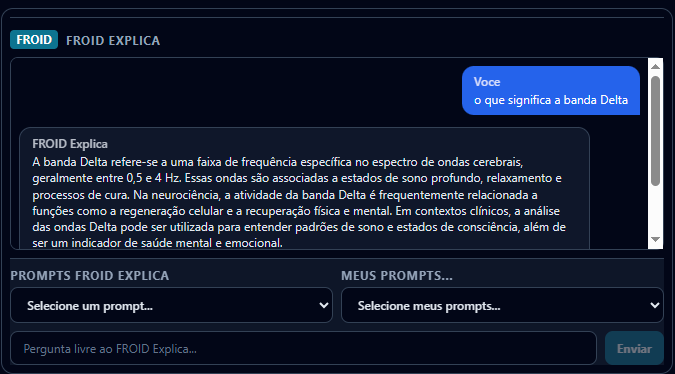
FROID Explains interface: a professional's question and the assistant's grounded answer, with selectors for pre-configured and custom prompts.
FROID Explains interface in the professional panel. A demo video may replace this image in the future.

How it works

Two brains, one conversation

FROID Explains decides, for every question, whether it is about knowledge (how to interpret the reading) or about data (how this patient compares to the base) — and routes it to the right engine.

RAG · Knowledge

Explains the clinical reading

Retrieval-augmented generation (RAG) over FROID's verified knowledge base: 12 Zones, IPM, IDM, biomarkers, FACS, and the scientific bibliography. Answers "what does this dissonance mean?" with grounding — always about already-calculated metrics, never generating the acoustic values.

Analytics · Data-Froid

Compares against the population base

Analytical queries over the anonymous Data-Froid: "is this patient above average in risk?", "most similar cases (top 5)", "most effective interventions for similar profiles." Your roster's intelligence meets the intelligence of thousands of sessions — with no PII.

FROID proprietary framework

What Explains sees: the consolidated screen state

Every query to FROID Explains receives the consolidated state shown on screen — the moving clinical window from Clinical Screen Stabilization (default: 5 minutes, temporal weighted average) — with access to recent raw data when needed. This way, the AI's answer talks about exactly what the professional is seeing, with no divergence between screen and analysis.

This and other proprietary algorithm definitions are documented in internal references consulted by the RAG engine — e.g., FROID_Estabilizacao_Clinica_Da_Tela.md, which records the metric, the weighting math, and the module's clinical rationale.

Language engine built on state-of-the-art models (e.g., Gemini / GPT-4o), with safety verification on every response. Architecture details in Technology and privacy in Security.

Portfolio intelligence

From reading a session to the conduct that sets your clinic apart

FROID Explains is not limited to explaining a single session. During and after the appointment, it reads the transcript — with the patient's and the professional's speech separated —, the biomarkers, and the history, and cross-references that material with your portfolio. This is where the difference is born: associations no one would make by hand, patterns that emerge only when you look at the whole, and the basis for you to shape your own clinical conduct.

Associations

Cross-links that reveal the non-obvious

Ask Explains to relate metrics, speech, and sessions: how a recurring dissonance speaks to a specific theme, how the recommendation given in one session echoes in the next, what brings two seemingly distinct cases together. It raises association hypotheses for your judgment — never a diagnosis.

Portfolio patterns

New patterns across your patients

Locate patterns that appear only in the aggregate: sustained IPM drops, responses that repeat across similar profiles, evolution across sessions. The comparison strictly respects access controls — in multi-professional clinics, each person sees only the patients the administrator authorized.

Your own conduct

The approach only your clinic has

Turn those findings into your own conduct: protocols, intervention sequences, and follow-up criteria tuned to your cases. It's the path for your clinic to differentiate itself in approach and in patient recovery — building, session after session, a method with your signature.

FROID Explains is decision support: it organizes signals and raises hypotheses for the qualified professional, without replacing clinical assessment. Every data cross-reference respects organizational segregation and the access controls described in Security and Ethics.

Prompt library

22 pre-configured prompts, ready for the session

One click in the panel triggers any of these. Half read the session in depth; the other half cross-reference the patient against the anonymous population base.

Clinical reading of the session

Grounded interpretation of the current indicators (knowledge engine / RAG).

  1. Explain the clinical reading of this session's dominant zones.
  2. What does the current IPM suggest about the patient's emotional energy?
  3. How should I interpret the observed facial-vocal dissonances?
  4. Which bioacoustic markers deserve attention right now?
  5. Explain the difference between IPM and IDM for this session.
  6. What clinical questions could deepen this reading?
  7. Explain the session's overall summary and its 10-minute segments.
  8. What changes occurred between the baseline and the session average?
  9. Which recorded dissonances require greater clinical attention?
  10. How should I interpret this session's acoustic biomarkers?

Comparison with the Data-Froid

Cross-referencing the patient against the anonymous population base (analytics engine).

  1. How does this patient compare to the population average in FROID Zones?
  2. Identify atypical patterns compared to the database.
  3. Is this patient above or below average in clinical risks?
  4. Progress over the last sessions versus population.
  5. Speed of improvement compared to similar cases.
  6. Which conditions in the base have a similar vocal-facial profile?
  7. Most similar cases to this patient (top 5).
  8. Most effective interventions for similar profiles.
  9. Prediction of therapeutic response based on analogous cases.
  10. Alerts: risk patterns identified in the population base.
  11. How does this patient compare to the anonymous population base?
  12. What patterns appear in similar cases within the anonymous base?

Personalization

Create your own prompts

In their settings area, the professional registers their own prompts — recurring questions from their approach, theoretical framework, or specific patient population. They stay saved to the account and accessible in one click, alongside the 22 native ones.

Every custom prompt can query both your patient roster and the anonymous Data-Froid — combining what only you know about your cases with the statistical power of thousands of sessions worldwide. This crossing is what creates the big differentiator: the more the network grows, the more your questions get answered on empirical grounds.

  • Personal prompts saved per professional, in the settings area
  • Access to your own roster + the anonymous population base
  • Over time, they empirically validate the IPM, the IDM, and the other proprietary metrics
Example of a custom prompt

"My patients with an IPM drop"

"Among my patients, which ones had a sustained IPM drop over the last 3 sessions, and how does this pattern compare to analogous cases in the Data-Froid?"

The assistant combines the reading of your roster with the anonymous base and returns a grounded answer — the clinical decision remains yours.

Custom prompt settings screen: short title field, full prompt field, and save button.
Settings area: the professional creates and saves their own prompts, tied to their account, alongside the 22 native ones.

The base that learns from the world

The Data-Froid: the largest anonymous clinical perception base

A growing repository with the transcript and anonymized signals of thousands of sessions conducted worldwide — devoid of any personal information (PII) — designed to be explored by very large-scale models in search of new paths, metrics, and clinical associations.

Thousands
of anonymized sessions
k ≥ 50
guaranteed k-anonymity
0 PII
one-way hashes
1.2 tri
analysis parameters

As the network grows, this collection is analyzed by intelligences with more than 1.2 trillion parameters, capable of mapping associations no isolated session would reveal — and of progressively converting the IPM and IDM heuristics into statistically validated metrics. This is FROID's engine for population-level validation.

Honesty commitment: the Data-Froid is the path toward validation over time, not a finished proof. Today, IPM and IDM remain qualified engineering parameters; the base grows to prove them. Anonymization and limits are described in Ethics and Security.

Explore FROID Explains in practice

See the interactive demo or talk to the team about a pilot.