Knowledge
Retrieval-augmented generation (RAG) selects relevant passages to support the answer about the product and its concepts.
FROID Explains
FROID Psique / Assistant
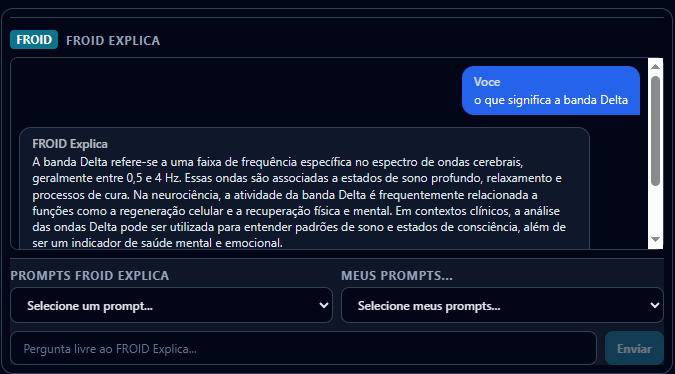
FROID Explains helps the professional explore the operational meaning of the available measures and consult knowledge. The context sent by the screen guides the answer; the clinical decision stays with the person providing care.
Retrieval-augmented generation (RAG) selects relevant passages to support the answer about the product and its concepts.
The measures table on screen, the baseline and every segment of the session, each with its deviation from the baseline computed by the server, plus the transcript with the time of each line. In the report, the assistant answers with one table per segment. When the question compares, it looks up the patient's sessions, the patients of the person asking and the clinic aggregate, always under the same access the person already has in the panel. To place a value, it looks up the Data-FROID population reference: the distribution of a measure across the anonymous session corpus, with a cohort floor and no number below it, computed by the server. A question does not expand permissions.
Querying Data-Froid depends on the eligible base and on privacy conditions. It does not give access to other people's records.
The search locates material related to the question; the model drafts an answer with that context. As in a literature search, finding a passage does not guarantee the conclusion is correct.
Check the source and the original records. RAG does not eliminate errors, and model size is not a measure of clinical accuracy. Missing data must continue to be declared as missing.
The native library offers starting points. Your own questions let you spell out the objective, session and interval. The number and availability of prompts follow the app version.
In your own prompts, prefer a clear objective and context. Do not include identifiable data of third parties outside the authorized context. Confirm in the app where questions are saved and whether they sync across devices.
The assistant must not conclude authenticity, facial-vocal conflict, diagnosis or the superiority of a therapy from the indices. Facial interpretation remains separate from vocal interpretation.